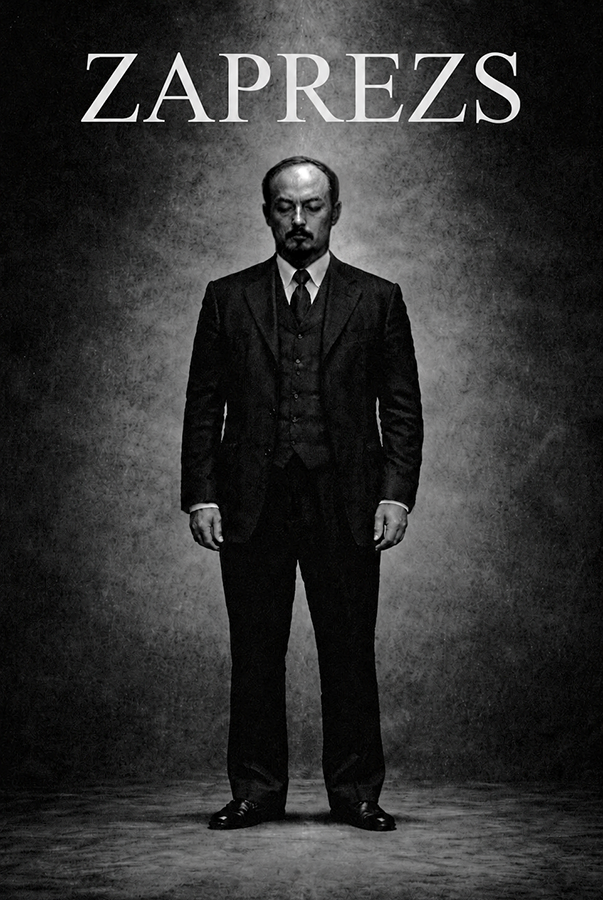
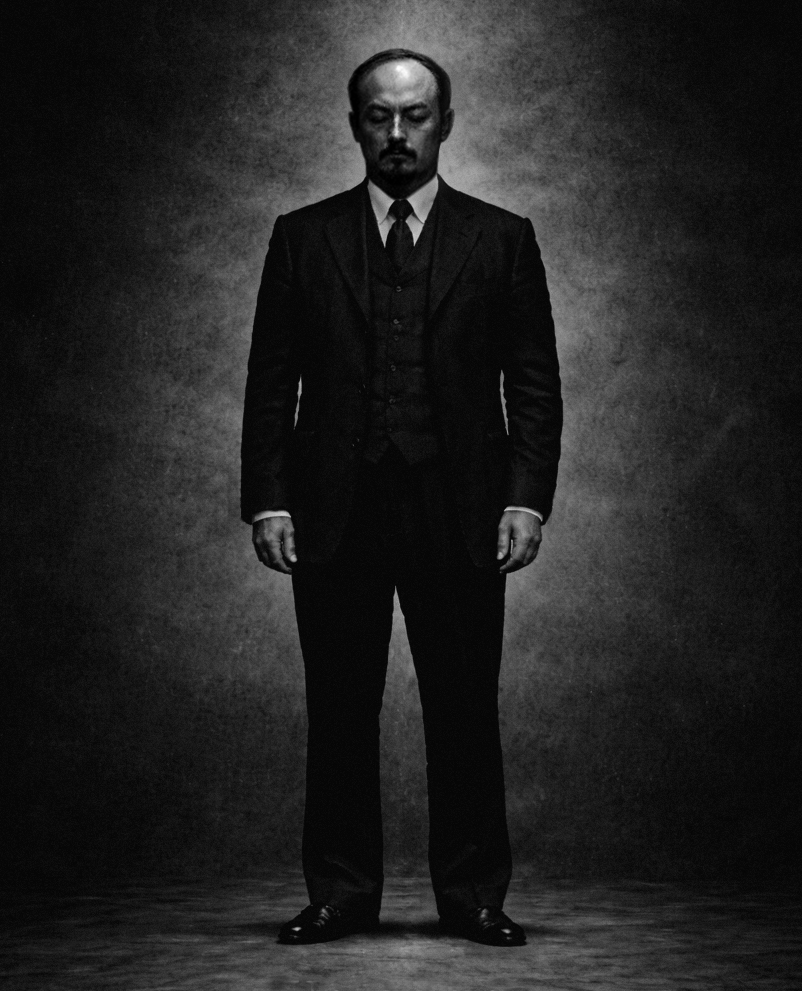
Zaprezs placed the toes of his unpolished shoes at the exact edge of the stage. His attire had been treated with meticulous care to suppress all light and all reflection. The only white was the collar of his shirt, which pressed the flesh of his jowl against his jaw and pushed his head back. The whole body followed: erect beneath a close-fitted frock coat whose edges blurred into the black behind him. An overhead light tracked his hands, and everyone believed it was their own dazzled eyes that guided it. His profile remained in shadow, framed by a beard of precise lines.
Darius Zaprezs, the enigmatic magician come from the east, did not handle playing cards or pull flowers from a hat, did not cut ropes or swallow billiard balls. All of that struck him as vulgar entertainment, unworthy of a man who had faced the abysses of life and trodden the limits of existence. True, in his day he had played with such trifles himself, the typical fare of the conjuror, but he had set them aside as a child sets his toys in a corner on growing up.
Of the traditional tricks, he kept only those that destroyed and reconstructed. Only those, in his view, answered to the final purposes of creation. He was drawn above all to the guillotine, but he knew, like everyone, that the body was never truly cut, that the blade was false. No — that was not real magic. The blade had to cut in earnest. No mirrors, no false doors, no doubles or other deceits.
And what greater proof of truth is there than pain? The magician would warn that no effect could mask such a truth, and would call for a volunteer. On this occasion, a man climbed the steps with the unsteady gait of the drunk. No one else dared. The volunteer challenged with his unguarded gaze the pretentious magician who addressed them from the heights in a foreign accent. Let’s see if you really can do what you boast — he seemed to say in his silence — and if it’s true, I’ll show you how an Irish sailor bears pain.
The man slid his arm into a small guillotine aimed at the centre of his wrist. Slowly, in plain view, Zaprezs tied a tourniquet around the man’s arm just below the armpit. Only then did he allow himself a joke:
“The staff don’t want to clean up the blood.”
Nobody laughed. Beneath the volunteer’s hand sat a basin to catch what would come. The magician spoke no more, and everyone felt his dark gaze fixed on them, on each eye, certain that it would happen exactly as he had described — no tricks, no deviations.
Zaprezs pulled the lever and the hand fell at once. From the opening of the guillotine spurted a blackish jet. The volunteer, who had braced for the blow with his head bowed and his other fist clenched, let out a cry that came a few seconds after the amputation. First he tried to wrench his arm away, but it was held fast by straps. If the man, as on this occasion, was drunk, he would often vomit and lose consciousness, left hanging there with an armless wrist in the air and his body slumped beneath the machine.
The magician, without a flicker of agitation, approached the fallen object slowly and lifted it as a butcher offers a cut of meat. He displayed the clean severance and brought it close to the audience, who turned their faces away. Many wished to leave or to cry out, to denounce the madness before them, but they remained in their seats, held fast by the strange figure of Zaprezs. He set the trophy on a silver tray and approached the fallen man, untied him, and raised him as though lifting something stuffed with feathers, settling him into a chair. Then he covered the amputated hand with a black cloth and carried it to its home at the end of the arm he held aloft. He joined the pieces beneath the cloth and worked like a mechanic.
“One dies in the light, one is born in the darkness,” he said, before pulling the cloth away in a single motion. The arm was intact. Finally, he held a pinch of powder beneath the volunteer’s nose, which revived him at once — but though his eyes opened, his will did not. With difficulty, he got to his feet and left the stage like a puppet dragging threads no one was pulling.
The magician did not wait for applause. He never received any.
Whispers carry news that no one proclaims aloud. So it was that the presence of a sinister foreign magician became known throughout the city. No one announced him, yet his performances grew steadily fuller.
The moment came when Zaprezs, satisfied with his success, wished to go beyond the mere amputation of hands and feet.
“Tonight, dear audience,” he announced, drawing out his words, “you will witness a real decapitation.”
Everyone looked at him as though sharing a collective hallucination.
“And an equally real resurrection.”
The magician was not waiting for volunteers. Only his assistant was willing to offer his body for such a sacrifice. Urguz was, in his manner and his appearance, the very opposite of his master: a broad, stooped man with long arms and thick hands that hung almost to the ground. His skull was a tangle of scars, and his stony face was perpetually shadowed by a drowsy rage. This creature fitted his neck into the stock like a trained beast. His indifference suggested that some crude trick lay behind the spectacle, but the magician avoided every form of sleight of hand with fastidious care. There was nothing on the stage but the dark wooden guillotine and the body trapped within it. A metal trough beneath the head completed the props. When Zaprezs pulled the lever, a sharp blow severed Urguz’s head, which fell bathed in a rush of blood. The brutality of the act, before which few managed not to look away, drew a brief, unison shriek from the audience. Then they watched in exhausted silence as the magician raised the head and displayed it. He laboriously settled the corpse in a chair and rejoined the two pieces beneath the concealment of the black cloth. The decapitated man emerged whole, covered in blood. The powders beneath his nose revived him.
Amid a horrified silence, Zaprezs bowed to receive his glory and withdrew, followed by his servant.
Only once did he have a volunteer for the decapitation. By the time his performances had drifted into the clandestine, held before a dozen sadists gathered in the cellars of a disused prison, a tall, elegant young man rose with a defiant gesture. Zaprezs noticed at once that his pupils crackled with the effects of some drug, and turned that hypnosis to his advantage. The young man lost consciousness a second before his head did. When it hung from the magician’s hand, no one present doubted its reality.
After the reassembly, and already in the privacy of the wings, the blood staining the volunteer’s face was wiped away in haste. As he left, he was seen wandering the surrounding streets like a living dead. When asked what he had felt beneath the blade, he claimed to remember nothing and showed every sign of being on the edge of derangement. A few days later, his body was found in a dark alley. The autopsy attributed the death to a heroin overdose and noted a very fine scar around the neck. The slightness of this mark was not enough to keep Zaprezs from becoming, from that point on, a forbidden magician.
Those who continued to seek him out threw themselves into the work of helping the magician hide. No one spoke of him, no one knew him — yet he had a following of admirers who, summoned in secret, came to witness his art in ever-changing locations. Conscious of his patrons’ taste, he devised a variety of executions. He ran bodies through with swords, split them in two, or broke them apart with a Spanish garrotte. Urguz was the taster of these ordeals, but there were always volunteers who, driven by curiosity and the accounts of some predecessor, wished to feel the shock of a real execution. Pain, if not forgotten, fell away like a fleeting nightmare that fortified one for torments to come.
Not all of them, however, were drawn by the morbid thrill of the killings. Some watched with distaste, yet remained, held fast by the personality of a man whose magic they sensed as real, even when reason cried out that such things were not possible. For these delicate souls, Zaprezs devised a new effect. It was no longer a matter of killing in order to revive, but of reviving in order to kill.
Gathered in a remote cemetery, by the light of a fire and a moon veiled by the storm, a group of people formed a circle around a grave. Aided by two well-paid labourers, Urguz strained to shift the heavy marble and draw out a coffin of rotting wood. Before them, the magician moved his hands slowly, as though conducting an adagio. When the coffin was opened, they tilted it slightly toward the audience so that they might contemplate the desiccated body of an old woman wrapped in the finery of eternity. Then the magician covered her with the black cloth and passed his powerful hands along its length. A bluish radiance appeared at the edges before the cloth was drawn away. The corpse appeared wrapped in this faint spectral halo and began to tremble, as though the worms that inhabited her had taken to dancing. Zaprezs slid his arms beneath her back and helped her rise. Held up by invisible threads, the old woman stood before the astonishment of all. Then, unaided, she took a few steps and gaped. At last she opened her eyes and showed the black abyss of her empty sockets. Fearing the thing might throw itself upon them, the onlookers drew back, ready to run, but after a clumsy bow the revived woman halted, floating in the centre with her arms hanging at her sides. The magician, who understood her wishes, helped her return to her bed and ordered that she be sent back into the depths.
After one such performance, when all had departed, a solitary man waited to speak with the magician. Zaprezs always concealed his routes and could have slipped away unnoticed, but he sensed that the offer awaiting him might merit his attention.
“My daughter Clara, a child of just thirteen, was buried two days ago,” said the stranger without preamble. “I want you to bring her back before the colour fades from her cheeks.”
Zaprezs looked at him with studied hauteur and let his words come slowly. He thought of feeding off the man’s pain and answering with something like: The dead know only the road to dust. Instead, he asked drily how much the man was prepared to pay.
“Whatever you ask.”
“The sum will be immense.”
“So is my fortune.”
“Very well.” Zaprezs had his prey. “But it is a deeply intricate effect. It will take time — by then the colour in Clara’s cheeks may no longer be recoverable.”
“It does not matter. Give her back to me and I will give you everything I have.”
To prepare the resurrection, Zaprezs was given all the information he asked for about the girl. He surrounded himself with her portraits, her letters, her childhood poems, her dresses. Two weeks after the agreement, the father received the long-awaited summons to his daughter’s graveside. No one would disturb them. Only the parents and the magician’s assistants would be present. There was no audience to impress, but Zaprezs could not dispense with his stagecraft. His art stood above science and mere technique; it required the precise execution of the ritual — arcane words and gestures whose meaning he alone knew.
When the henchmen had the coffin open before the stricken parents, he let them look at their daughter for a few seconds. The girl lay sunk in the depths of the casket, pressed among the unnecessary padding that bedded her. Her grey skin still held over the flesh, at least on the surface, and what lay beneath the eyelids seemed to concern no one.
The magician, with his measured elegance, covered Clara with his black cloth. This time the bluish radiance was more intense than ever, but it died abruptly the moment the cloth was lifted away. The girl did not move, and the parents feared all would end in failure. Zaprezs, however, conceded not a fraction of his bearing. He approached slowly and laid a handkerchief steeped in vital essence over the face of the sleeping child, then slipped his arms beneath the body and lifted it from the coffin. When he released her, Clara remained upright, held by a wind that made the gauze of her dress and the loose strands of her hair float about her. The mother moved to throw herself upon the girl, but the magician halted her with a stern gesture and said solemnly:
“The soul has not yet returned.”
All waited in patience until a convulsion shook the child’s chest. A thread of saliva ran from her mouth and Zaprezs hastened to wipe it away, then carefully lifted her chin, and the eyes opened. The vacant gaze was unable to express the terror of return. No one could comfort that aberration, forced to make the journey against nature.
“She has seen what no one else has yet seen. Do not expect her to be the same,” declared the author of that wonder. He took the girl by the hand and led her to her parents, who embraced her in tears. The sallow cheeks did not trouble them at all, nor the spent eyes, the absence of a smile and of speech, the total oblivion of her name and of her former life. Their daughter was back.
Zaprezs collected his price and disappeared. But no one can keep an act like that secret, and before long he was sought out by other wretched souls. Those who looked for him did so kindled by the silent legend of a man capable of miracles. They called him sorcerer, necromancer, prophet. Only a few found him: those whose fortunes were enough to buy the will of the demons who, so it was said, worked for him from the shadows.
On the magician’s advice, Clara’s parents kept her from the eyes of doctors. Few, in fact, knew of her return, and those who did were persuaded by the lie that she had not truly died but had been kept in a distant sanatorium. Some who had attended the discreet funeral resisted before that portentous reappearance, but they soon yielded. Clara was there with her green eyes and her upturned nose, with her teeth held tight behind her small mouth and her straight black hair braided over her shoulders. She was there, and yet she was not. Her only words were monosyllables uttered in an inhuman tone; her gaze lost itself at the far end of the garden, where she would spend hours doing nothing. On the pretext that any company disturbed her gravely, no one was allowed near her — and so no one was able to see that, in truth, that adolescent face was a death mask twisting features that had once been alive.
Not all of the resurrected, however, conducted themselves with such docility. Within a few weeks, Lucien’s parents wished their son had not come back. The interruption of their grief by that misshapen and savage creature opened their eyes to the divine meaning of existence, and they came to repent the monstrosity they had committed. In desperation they sought out the magician, but he refused to show himself before them again.
Other troubles came to harass him. Word reached his ears of the stories told in the harbour taverns about a bloodthirsty creature that prowled the alleys of the lower quarters. The confused descriptions were enough for him to recognise Urguz, whose clumsiness was placing them both in danger. He had thought he had quelled his servant’s extreme lasciviousness, but he learned now that the lackey had blundered with some girl who had had the misfortune to cross his path. Cautious and flush with money, he hurried to conclude the last resurrection he had agreed to. With that transaction closed, he let it be known to anyone who might be listening that there would be no more. He still had to endure the pleas of one final supplicant, before whom he wielded a dreadful excuse: the Reaper had visited him to warn that he must abandon his presumption.
“Whoever undoes my work gives his days in exchange — so the winged shadow told me.”
The man paid no heed to this account and pleaded until, resigned to his misfortune, he turned his weeping into insults that swelled until they covered the magician in the foulest curses. Zaprezs had exchanged an imaginary enemy for a real one. He knew this end was inevitable, and that worse things awaited him if he did not act cleanly and quickly. He returned to his lair and ordered Urguz to gather everything and erase any trace.
But it was not his intention to renounce his art or return to the old tricks. Tired of flesh and bone, he aspired to the supreme conquest of the soul. Several months later, in another place and before other eyes, he presented his new creation. Seven men and two women were assembled on a circular terrace roofed with glass panes. Rivulets from the storm slid along the facets and met at the steel rods that held them. The location had been chosen by another, and the magician had only known of it a minute before the performance began. It was therefore not possible for anyone to suspect the presence of hidden mechanisms.
“The volunteer will feel no pain,” he said by way of introduction. “His death will be clean, and his soul, tamed by my art, will show itself among us and behold its own body. Only I can make it return.”
A tremor passed through those present. A volunteer had been called for, but no one moved. This time Urguz was not there to whet the appetite — his coarse, unkempt body harboured no soul worth extracting. Indifferent to the silence, Zaprezs held himself upright in the centre of the room. His eyes rested on no one in particular, yet everyone felt them fixed upon them. At last he turned his gaze to a man who had drawn his attention: a young man with pale hair and a freckled face who stirred uneasily inside an oversized dark suit. The moment the magician picked him out with his eyes, he felt himself compelled to rise. Once on his feet, in full view of all, his fear dissolved and a comforting warmth carried him out of his surroundings. The others watched as his eyelids closed and he sank into a placid, seeming sleep. Zaprezs nudged him gently and helped him lie down on the carpet. Then he set his fists on the young man’s chest as though gripping something, and a white light formed around them. He pulled with feigned effort, and the light shaped itself into a silhouette that rose to a vertical stance — but it was no more than an unrecognisable mass.
“He is now sunk in unconsciousness,” said the magician. “When I command it, he will awaken and take possession of himself again.”
The command was given in a word unknown to all. The image of the volunteer drew itself over the light until a perfect double was complete. The carnal body lay still on the floor, its chest motionless, with no other sign of breathing. The spectre looked about itself in wonder and fear, trembling as it struggled to keep its footing on a floor whose gravity it could not feel. Zaprezs tugged an invisible cord and the soul took two steps through the air, turned to face the audience, and moved its mouth in an attempt to speak. Nothing broke the funereal silence that paralysed the room. There was no further display. Once shown, the light fell gathered into the arms of its summoner, who kneaded it into a silver sphere and pressed it into the forehead of the young man lying face up. Through clipped spasms, the body returned to life and rose with effort. The spectral gaze was unchanged. Sure of his triumph, Zaprezs was leading the young man back to his place among the audience when someone dared speak with insolence.
“Is that all you can do?” said a deep voice. The transgressor was a dark-skinned man with broad shoulders, a piercing gaze, and an air of self-assurance.
The magician ignored him and finished his protocol, took his place at the centre of the stage, and waited for the other to release what he still held in reserve.
“A trick of light and a touch of drug,” the provocateur went on, unable to stop himself.
“Would you care to try a real death?”
“A real death? Nothing but trickery.”
Convinced that nothing more would come of the exchange, Zaprezs gave a bow of farewell.
“Where is your lackey?” The question caught the magician off guard, though he did not let it show, and he hastened to leave. “Have you got him out roaming the streets in search of replacements?”
Soon afterwards he learned that Lucien had escaped from his home. Like a wild dog, he had bitten his keepers and leapt from a window. They searched for him by night in the woods, but found only the traces of a tireless march that ended at a river and led on into the city. There he attacked several people before being captured. His parents had not reported his disappearance, wishing to guard their secret at all costs, and so the police were left to piece together his identity blindly. They learned that he had vanished several months earlier in a distant suburb — how had he survived since then in such a state? Loose ends connected him with a surly individual who had been drifting through similar places.
No shadow could conceal Urguz. A bare description was enough for two guards to recognise him at the door of a tavern. They followed him and cornered him at the back of a brothel, where they took him in a net as though he were a beast escaped from a circus. Once they had him bound in a cell, they could draw nothing from him but grunts and clipped words. They untied him and let him sleep, the better to have him fresh and clear-headed. Only then did they apply the most sophisticated means of persuasion at their disposal. They wanted his name, his origins, and his motives, but Urguz resisted every question and answered only with laughter and a harsh humming. They did not know that for this man pain was a way of life, a routine. Needles under the fingernails were a caress to him; his bones were broken in a thousand places; his skin was the rugged terrain of a land of scars. They gave up on him as useless and confined him to a dungeon. By other means they managed to link him with a mysterious magician from the east who, in recent months, had been displaying his sinister abilities in clandestine venues.
A manhunt was organised against Zaprezs that forced him to abandon his trade altogether. That loss of self threatened to plunge him into despair, but he was a strong man and brushed aside such faint-hearted feelings with the back of his hand. He had always taken unforeseen events as opportunities to discover new horizons. On this occasion, he was curious to know what the police had learned of him, and he allowed an inspector to find him. With a trail of false clues, he led him to his last hiding place, the attic of a disused warehouse, barely lit by the light that filtered between the boards sealing the windows. Believing that an informant awaited him there, the inspector entered cautiously and climbed the stairs with one hand on the grip of his pistol. He was a man with a long, bony face, who scrutinised everything through small, sunken eyes beneath a broad, prominent forehead. The visitor found a clean, open space, in the centre of which stood a stretcher draped with a white sheet. The shape at once suggested a body concealed beneath it. He moved to approach, but a voice froze him. He knew, though he had never heard it before, that it was the magician’s voice.
“Like a surgeon, I too must pursue my studies,” said Zaprezs in a languid tone. The inspector looked about him and saw no one. “How is my servant faring?”
“Show yourself.” The man raised his pistol.
“Will you shoot me? I am unarmed.”
The figure of the magician took shape at the back, as though a light were drawing it from within the shadow itself. Behind him, the faint glints of several glass jars revealed the existence of a long shelf.
“Your slave has confessed everything. You would do well to surrender.”
Zaprezs, who knew perfectly well that this was untrue, let out a low, sinister laugh.
“What crime am I accused of? I have killed no one — quite the opposite.”
“You have desecrated graves and abducted several minors. Shall I go on?”
“The graves were opened with the consent of the families, and I have abducted no one.”
“You sent your henchman to do it.”
“Urguz was a savage when I found him. My failure to root out his impulses entirely is a small disappointment to me. In any case, I am not answerable for his excesses.”
“And that body?”
“Come closer and see for yourself.”
The inspector felt then that the magician was toying with him. He had set a bait, and he had bitten like a fool. He understood that he was caught in an invisible cage, and that the eyes watching him were morbidly dissecting his every gesture. Zaprezs already had the information he wanted. He observed his prey and blew from his open hand a wind that wrapped around him. The man began to feel himself suffocating and dragged himself in distress in search of clear air. He found it on a landing of the staircase, where a window of broken glass let in his remedy. There he stayed until he lost consciousness and fell rolling down the stairs.
The fate closing in on Zaprezs offered him the chance to show the world the immensity of his power. In his own hand he wrote an elegant letter to the police announcing his next performance. The pretentious summons was not taken seriously; even so, they could not refuse to attend the appointed place.
At midnight, the temple was cleared and surrounded by two brigades. All the lights went out, and the twisted, elongated silhouettes of the pinnacles dissolved into the blackness of a moonless night. Through that darkness, seven men advanced along the central nave, guided by the circle of a lantern. When they reached the middle, they aimed their lights in every direction and stood in silence, hands on weapons, alert to any suspicious sound. Around them, a gallery of distant echoes betrayed the slow movement of the stones in their advance toward ruin. The inspector at the head — the same man the magician had lured and then expelled from his laboratory — looked at his watch: a few seconds short of one o’clock. Just then, a procession of dry strokes confirmed the punctuality of their host. After the chiming, a voice thundered from on high in a foreign tongue.
“What game is this, Zaprezs?!” shouted the inspector.
The figure addressed did not break off his recitation. A pale halo appeared hanging from the retable, whose gilded ornaments shone the brighter to exalt the figure of a man dressed in black.
“The building is surrounded — you have no escape! Enough of your games!”
“Tonight I shall offer myself in sacrifice!” the magician answered at last, in an apocalyptic tone. “My altar of fire shall be adorned with your souls.”
Zaprezs descended slowly until he came to rest on the floor, wrapped in a sphere whose light was enough to fill the whole space. Within it crackled the electric arteries pouring from his body. The policemen began to feel a weight on their chests, and their mouths ran dry from the acrid odours given off by the thing approaching them. The magician raised a bare hand and feigned a threat that the others took for real. A burst of gunfire passed through the sphere, and the men fell exhausted. Zaprezs did not alter his expression and made ready to show them that what loomed over them was real, and not a mere projection. He extended his bubble until it enveloped the nearest man and took him by the shoulders. He held him upright and left him in the middle of the aisle. Then everything went dark. A spark caught the policeman’s body, which within a few seconds became a pyre that stretched out its fiery arms until they seized the lowest beams. His companions watched in horror as his body became a black mass that slowly crumpled in on itself. At once a rain of embers began to fall on them that would soon leave them no escape. They dragged themselves outside and watched the flames devour the temple and the two men who had remained inside.
At dawn, when the fire died beneath the charred remains of the building, a team of firefighters entered the ruins, escorting the inspector and other officials who had come to the scene. In the centre they found a small cavern that had formed by miracle among the debris of the collapse. At its entrance crouched a hunched man who was coughing. They lifted his head and saw the blackened face of the policeman his companions had watched consumed by the fire. Traces of a trickle of blood that had run from his nostrils still marked his skin, and his vacant gaze did not recognise his rescuers. At the far end stood a crucifix of just over three metres, whose crown seemed to support the irregular vault that had formed that niche. At its feet, a black cloth jutted from the floor of ash. Beneath it they found a decapitated body. A few red drops stained the only white part of his clothing. The precise scar had been cauterised by the same fire that had devoured everything.